
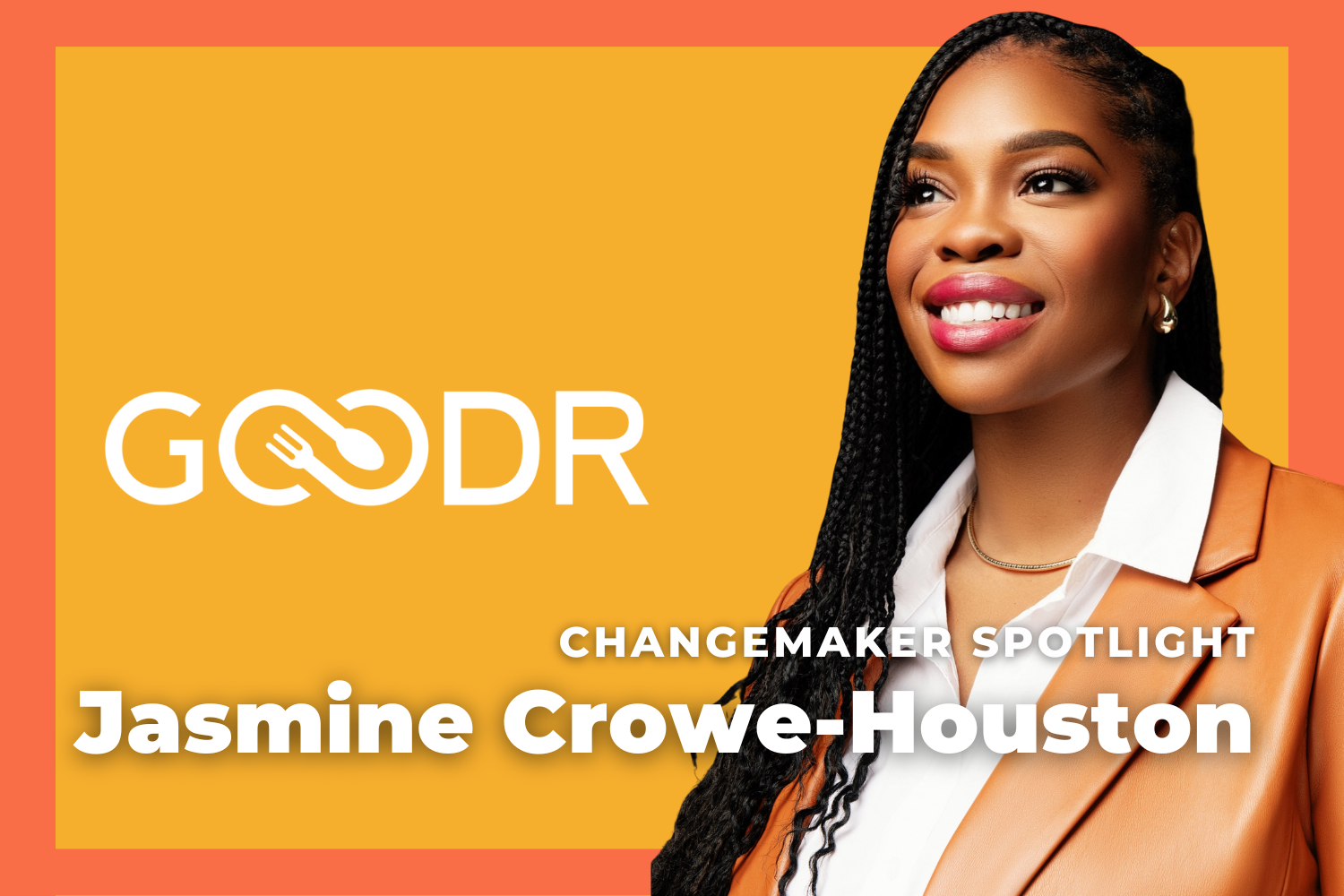
Changemaker Spotlight – Jasmine Crowe-Houston, Goodr
Welcome to Strat Labs’ Changemaker Spotlight Series! This blog series is dedicated to showcasing the inspiring journeys of remarkable individuals who have transformed their passions into purposeful endeavors, leaving a significant impact on the world around them every single day. Join us as we delve into the heart of innovation and commitment, celebrating the extraordinary stories of those who are not just dreaming of a better future but actively shaping it in their journey as a Changemaker.
Jasmine Crowe-Houston, founder and CEO of Goodr, has turned a simple but powerful realization that hunger and food waste are logistics problems into a nationwide movement. What began with feeding neighbors from her own kitchen grew into a certified B-Corp that has redirected millions of pounds of food from landfills and provided meals to millions of people. Along the way, her TED Talk “What We’re Getting Wrong in the Hunger Fight” has inspired millions and spotlighted her vision for creating food systems rooted in dignity. In this Changemaker Spotlight, Jasmine shares the experiences that shaped her leadership and the mission driving her work forward.

1. What inspired you to become a Changemaker, and how has that purpose evolved over time?
My inspiration was simple: I kept meeting people who were hungry, and at the same time I saw perfectly good food being thrown away. Years of direct service taught me that charity alone could not fix a logistics problem. That realization became Goodr’s founding thesis and still guides us today. We built a platform and logistics network that makes donation the easy choice, measures the environmental and social impact, and treats people with dignity while solving a supply chain challenge.
2. What’s a challenge you’ve faced in your journey, and how did it shape the way you lead today?
Early on, many assumed donations should be free and were skeptical about paying for surplus food recovery. We reframed the discussion around outcomes. Businesses already pay to haul waste to landfills, so we showed how paying for recovery creates measurable value through tax deductions, ESG reporting, and reduced disposal costs. That push for clarity built our culture around data, compliance, and trust—including a secure chain of custody and a $12M liability policy that gives partners confidence.
3. What does impact mean to you, and how do you measure it in your work?
Impact means changing the system so fewer people go hungry and less food becomes waste. We quantify that change with pounds diverted from landfill, estimated CO₂e avoided, and meals provided back to communities. In 2024 alone, our reporting showed more than 6.38 million pounds diverted, about 4.91 million pounds of CO₂e prevented, and over 2 million meals provided. We pair those numbers with storytelling from partners and recipients to stay accountable to real people, not just dashboards.

4. Who has influenced your leadership style or social impact work the most?
My leadership is shaped most by the communities we serve and the nonprofit partners who show up every day. Working alongside shelters, senior housing, veterans’ groups, schools, and youth organizations reminds me that dignity should be the default and logistics should never stand between people and food. Their consistency and creativity continue to set the bar for my own.
5. What advice would you give to someone just beginning their changemaking journey?
Start by measuring the problem you want to solve. You cannot manage what you do not measure. Once you see the data, it will point you toward practical levers you can pull, the partners you need, and the policy or logistics gaps you can close. And keep your solutions simple and repeatable so others can adopt them at scale.
6. Your work with Goodr focuses on food waste and hunger relief. What’s a story or moment that reminds you why this work matters?
I think about the school-based Goodr Grocery Stores that allow families to shop with dignity right where they are. At Ronald E. McNair Middle School, our collaboration created an in-school market that restocks regularly and meets real, daily needs. No lines in a parking lot. No stigma. Just access and respect. That model is one of many reminders that when logistics meet empathy, families thrive.
7. How is Goodr adapting to the current landscape of food insecurity?
We are pairing public support with private execution to deliver reliable food access at the neighborhood level. In Atlanta’s Sweet Auburn, the Goodr Community Market operates as a public-facing grocery with real-time inventory via Vori, SNAP eligibility, produce matching, and an integrated free-grocery program for more than 200 residents each month. Affordable prepared meals come from the on-site Little Loaf Deli. The store runs six days a week, and the model is designed for replication in other cities that want results without creating new bureaucracy.
8. Share about your food waste solutions and programs. What impact are you hoping they will have, and how can the community support it?
We operate two complementary lanes. Food Waste Solutions covers surplus food recovery, organics recycling, and holistic waste management for businesses. Hunger Relief Solutions includes pop-up grocery markets, mobile and at-home deliveries, in-school and community grocery stores, and student snack programs. The goal is circularity: less waste, more meals, and clear data to guide smarter production. Communities can support by partnering with us to host activations, engaging corporate philanthropy teams, and volunteering at events when opportunities are posted.

9. What’s something people often misunderstand about hunger or the communities you serve?
Many people believe hunger is about scarcity. We see every day that it is really about logistics and access. There is enough food. The work is building systems that move it quickly and safely to people while respecting their time and dignity. When businesses and governments treat this as infrastructure, not charity, outcomes improve fast.
10. As a leader in this space, what gives you hope for the future?
I am encouraged by how scalable the solutions are when everyone plays their part. We have already rescued tens of millions of pounds of food and delivered tens of millions of meals through markets and activities across the country, and we are still just getting started. Cities are asking smarter questions, companies are committing to measurable outcomes, and communities are leading with dignity. That momentum is real.
Jasmine Crowe-Houston reminds us that solving hunger isn’t about scarcity. It’s about logistics, dignity, and systems built to serve people first.
To learn more about the impactful and important work that Goodr is doing, or to make a donation to support their programs, visit their website at https://goodr.co
If you are interested in connecting with Jasmine to learn more about her Changemaker journey, you can connect with her on LinkedIn.